History
The story of 227 Abolitionist Place — from antebellum activism to a 17-year fight to save a home, and the community that won.
Highlights / Timeline
1851-1863
The Truesdell Years
Harriet Lee and Thomas Truesdell own the house. Duffield Street becomes a hub of abolitionist and women's suffrage activity. Working alongside Bridge Street AME, Concord Baptist, and Plymouth Church, the Truesdells help enslaved people reach freedom through what we now call the Underground Railroad.
1980s–2014
Mama Joy's Stewardship
Joy "Mama Joy" Chatel acquires the home and makes it a joyful center of Brooklyn's Black experience — offering refuge, love, and community to all. She passes in 2014, having kept the home's spirit alive through decades of change.
2004
The Fight Begins
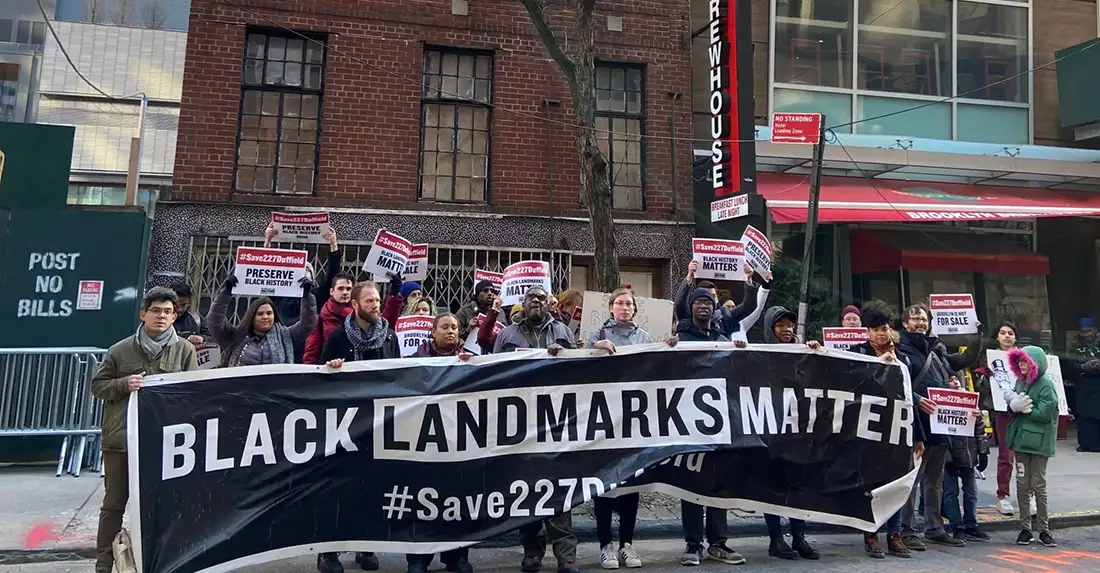
New York City attempts to confiscate and demolish the home through Eminent Domain as part of a broader effort that ravaged the neighborhood's character. The campaign to "Save 227 Duffield" is born.
Feb 2, 2021
Landmark Victory
After a 17-year fight, New York City's Landmarks Preservation Commission votes to officially landmark 227 Duffield Street. A community movement wins. The address is renamed 227 Abolitionist Place.
Today
The Work Continues
Mama Joy's biological family and her extended community of supporters continue the fight to transform 227 Abolitionist Place into a heritage center — a living archive of Downtown Brooklyn's Black history and liberation movement.

The three-story house at 227 Abolitionist Place (formerly 227 Duffield Street) is part of Brooklyn’s - and this country’s - deep history of radical activism.
Situated in the heart of Downtown Brooklyn, the building was once home to a family of prominent abolitionists who were central figures in America’s antebellum anti-slavery movement. Harriet Lee and Thomas Truesdell owned the house from 1851-1863, at a time when Duffield Street was a hotbed of not just local abolitionist activity, but also the women’s suffrage movement. Brooklyn’s local movement to support the liberation of formerly enslaved people centered on the churches on Duffield Street, including Bridge Street AME, Concord Baptist, and Plymouth Church. The Truesdells and their neighbors coordinated with these institutions, and their co-conspirators across the country, to help enslaved people reach freedom by any means necessary.
Through examining this background - which has been shared intergenerationally in both written and oral traditions - historians and community organizers have concluded that the house was likely a part of a network of direct abolitionist action that we now call, collectively, the Underground Railroad. In fact, Professor Cheryl LaRoche, whose academic career centers on the study of antebellum free-Black communities and their intersections with anti-slavery movements, has concluded that 227 Abolitionist Place is, “the most exciting location of Underground Railroad research in the country.”
However, as so often is the case with Black history in this country, the significance of this home has been ignored, challenged, and undermined throughout its history. Fortunately, the home found a champion and caretaker in Joy “Mama Joy” Chatel, who owned the home from the 1980s, through her passing in 2014. During that time, Mama Joy ensured that the home was a joyful center of Brooklyn’s Black experience, offering refuge, love, and community to anyone who was lucky enough to be in her, and the home’s, presence.
The contemporary fight to “Save 227 Duffield” began in 2004, when the city tried to confiscate and destroy the home through using Eminent Domain, which ravaged the character of the neighborhood. That fight continues today, through Mama Joy’s surviving biological family, and her extended family of supporters.
Friends of Abolitionist Place
Brooklyn, NY
Celebrate and Co-create With Us
Do you want to celebrate Brooklyn’s rich history of abolition and resistance with us?
Make a Donation
The work continues as we work to establish the Abolitionist Heritage Center